
DENTAL IMPLANTS

Dental implants are "artificial titanium roots" used to replace missing or lost teeth, with the aim of supporting a crown, a bridge, or a denture.

WHY AND FOR WHOM?

The placement of dental implants to restore one or more lost teeth is undoubtedly the best treatment option. Dental implants provide natural and aesthetic prostheses that are often difficult to distinguish from natural teeth. They restore the patient's chewing function safely and comfortably.

HOW DOES THE TREATMENT WORK?

There are several techniques and methods for rehabilitation with implants. A single tooth, multiple teeth, or even an entire arch can be replaced. The success of implants ranges from 90% to 98%, and in the event of losing an implant, another implant can be placed without increased risks.

Smoker patients can have implants; however, tobacco is a risk factor as it decreases the vascularization of the bone and gums, delaying healing and increasing the risk of infections. Diabetics can also receive implants, but they must be monitored.

After osseointegration, a crown, bridge, or prosthesis is placed on the implant to restore its chewing functionality and dental aesthetics.

In summary, dental implants are designed to replace lost teeth and can basically be divided into three stages:
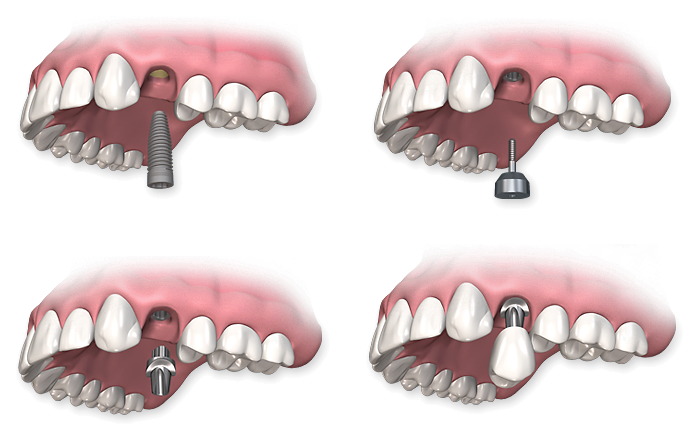
  • Root: First, the root, made of titanium or ceramic implant, is placed. The implant is done under local anesthesia. It is a very simple treatment, usually as quick as a dental restoration.

  • Temporary teeth: in many cases, temporary teeth can be placed on the implant on the same day or within 24 hours.

  • Permanent teeth: after a few months, when the biological cells accept the roots of the temporary teeth as part of the body, the dentist will complete the treatment by replacing the temporary teeth with a ceramic crown on the top of the implant, making it completely fixed.

FREQUENTLY ASKED QUESTIONS

Dental implants allow for the replacement of natural teeth and can be placed in the bones of the maxilla or mandible to support the force of eating, chewing, or "biting" like natural teeth. Tooth loss can be caused by other uncommon factors such as cavities, gum disease, and dental trauma.
The main reasons for contraindication are the placement of dental implants in children before the final growth phase and individuals who have an expectation above normal regarding results and aesthetics. People with high-risk heart problems, such as aortic or mitral valve prostheses, congenital heart diseases, or a history of infectious endocarditis. Other factors generally indicate a temporary contraindication or decrease the margin of success.
To perform the implant, the patient needs to undergo a minor operation to install the titanium cylinder in the bone tissue, in order to subsequently support the prosthesis. The placement of this metal structure is carried out in a small procedure in the office using local anesthesia. For more sensitive patients, analgesic ointment can be used even before anesthesia, which reduces the sensation of the injection.

Often, the post-operative period for implants is simpler and less painful than certain extractions.

Appointments

Our team is always ready to respond to your dental needs. Get in touch with us and schedule your appointment now!

PRICE list

Discover the prices charged by the Dental Clinic O Sizo.

SPECIALTIES

Dentistry

Orthodontics

Teeth Whitening

Dental Implants

Prosthodontics

Endodontics

Periodonthics

Oral Surger